Weightlessness?
Achieving weightlessness in various ways
In the precence of Earth's - or any other massive object's - gravity field, a temporary weightlessness is achieved when the studied object is let to "free-fall" towards the source of the gravity.
To get this done in science, several ways are used:
- A very short period of weightlessness (10s) can be obtained by dropping the object into
a straight deep shaft or down from a tall building. However, this action introduces air
friction, which decelerates the accelerating fall. For example, if a person jumps out of an
aeroplane, his maximum velocity towards the Earth is about 200km/h. If there was no atmosphere,
the object would accelerate constantly until the point of impact. In addition, this way of
obtaining zero-G makes studying the phenomena very difficult: the weightlessness is achieved only
for a very short-lived period, and there is no way of letting a researcher / observer to join the
object of study. And finally, the object must be decelerated before impact or be built from a
shock absorbing material (if it is needed to survive the impact).
- The object can also be flown outside the atmosphere. For example, the satellites,
shuttles and space stations stay in their orbits this way: they constantly fall towards the Earth,
but their "horixontal" velocity is so great that they in a way drop 'in front' of the Earth.
Because there is no friction of air, this sort of an orbit is quite stable: the farther out, the
fewer the air molecules, and the more stable the orbit. The changes needed to manouver in the
orbit are much smaller than in the weightlessness flights inside the atmosphere. The negative side
of this style are the massive costs, as the lifting of mass from the ground into space absorbs a
lot of energy. There is also a fact of repairing limitations: all the equipment anticipated for
repairs and adjusting have to be also lifted up.
-
By sinking the object into water, we can use the water's llifting force, which compensates for
some of the gravity acceleration (for objects lighter than water, the gravity is totally
canceled). However, in this case the environment of the object is drastically altered, as it is no
longer surrounded by gas but by a more sluggishly moving liquid.
-
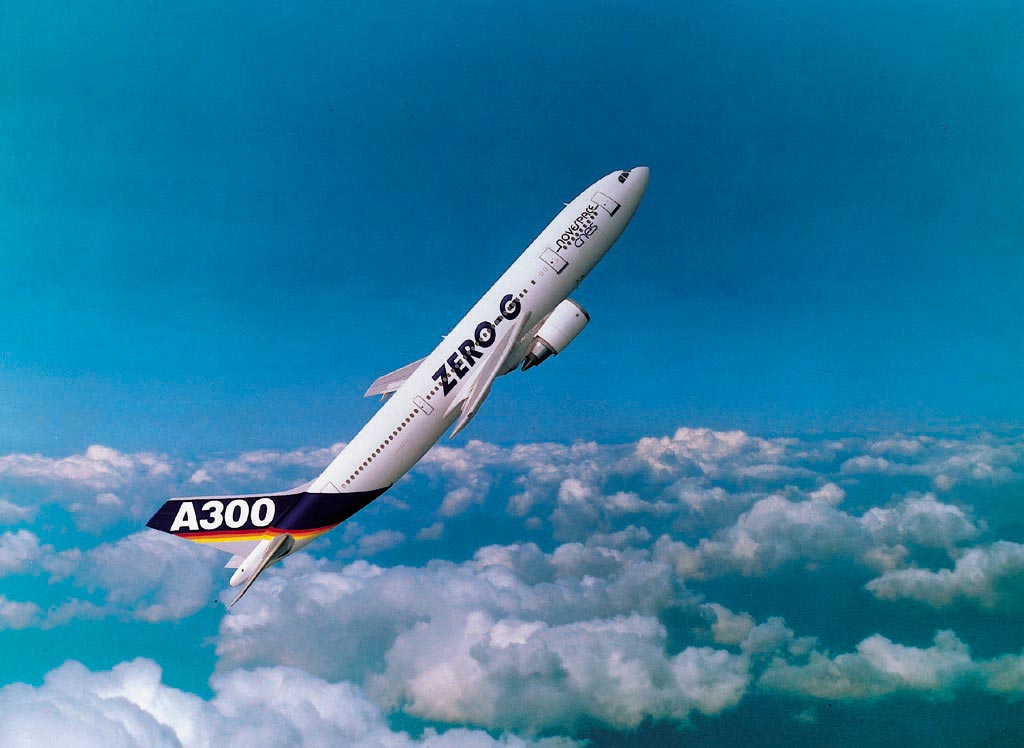
 For short time weightlessness experiments, the best and relatively cheap way is a weightlessness
flight on an aeroplane. In this scenario, the experiment is placed in a "zero-G" plane, which
thereafter flies on a parabolic flight pattern. The plane is most often a specially altered big
passenger carrier. At the top of the parabola the engines are turned to minimum thrust and the
plane is let to free-fall freely for a while (20-30s). During this time, in the inside of the
plane there is a near-zero-g environment, as all the surroundings is in a free-fall situation
towards the Earth. The air friction is only affecting the plane outer hull.
For short time weightlessness experiments, the best and relatively cheap way is a weightlessness
flight on an aeroplane. In this scenario, the experiment is placed in a "zero-G" plane, which
thereafter flies on a parabolic flight pattern. The plane is most often a specially altered big
passenger carrier. At the top of the parabola the engines are turned to minimum thrust and the
plane is let to free-fall freely for a while (20-30s). During this time, in the inside of the
plane there is a near-zero-g environment, as all the surroundings is in a free-fall situation
towards the Earth. The air friction is only affecting the plane outer hull.
A perfect weightlessness can not be produced in an aeroplane. Turbulence causes small forces to the plane and so the gravity is about 10 mg, one hundreth part of the normal.
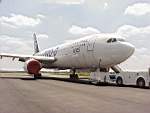
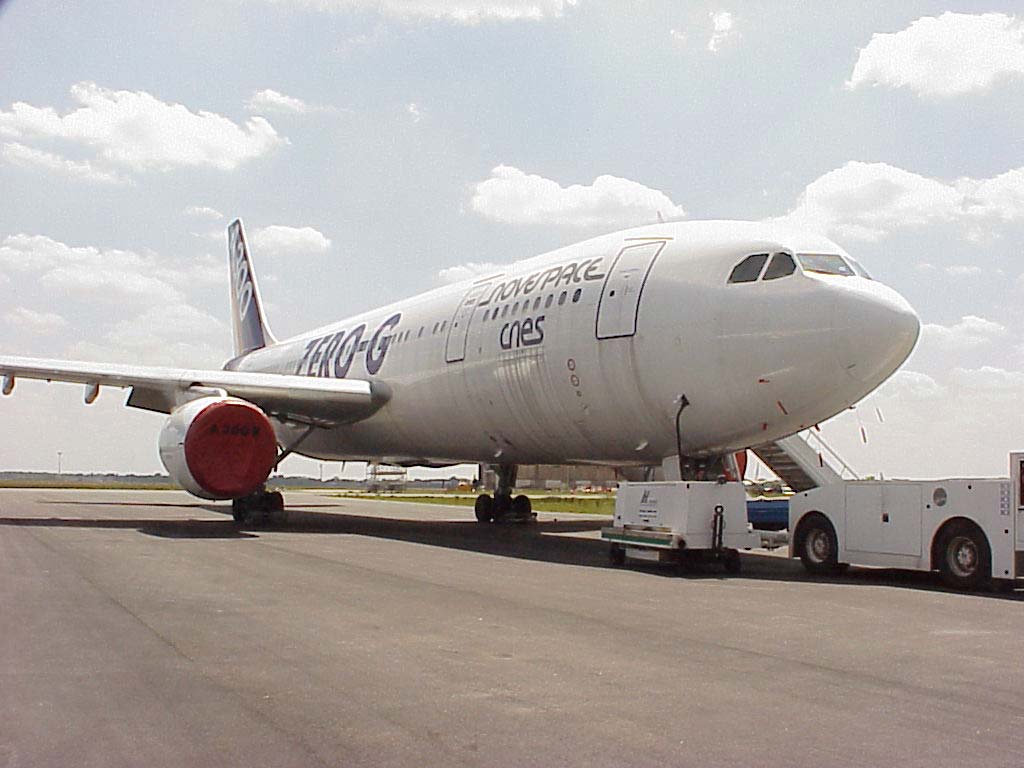
- The European Space Agency uses for its zero-G flights a modified Airbus 300 provided by Novespace. This is the biggest aeroplane in the world used for
weightlessness flights. For example cosmonauts have trained in the plane the assembly of antennas:
this helped them in succesfully achieving their goals in the real situation on the Space Station
MIR.
Weightlessness effects human physiology
Because we constantly experience gravity, we react to it unconsciously, In order to survive the constant down-pulling force, our body must go through countless small automatic movements and balancing reactions. Gravity is such a self-evident thing, that we become aware of it only very seldom, for example through varicose veins or when we stand up too fast and feel a bit dizzy. In real life, we only make note of gravity when we artificially increase or decrease its effective force: You can feel your feet pushing towards the floor of an elevator when you go up, as if you were suddenly 10kg heavier. The opposite happens when you go down, and the elevator accelerates "away" from you and you feel 10kg lighter.
In a short period weightlessness experience (such as this zero-g flight) the "absence" of gravity doesn't cause any major changes in a human's body. Possibly some of the passengers feel a bit nauseous as the sense of balance fails, just like in car sickness. Some may experience passing redness in the face or swelling, as the blood pressure still tries to push blood upwards with more pressure than downwards.
Longer duration weightlessness can however cause bigger problems: the mass of bone and muscles is decreased, and nausea, insomnia and fluid cumulation can occur, as well as depression and even different kinds of phobias. And of course returning to normal gravity will bring its own problems - the body must 'rehabilitate' back to normal conditions.
Orientation and nausea
The human balancing organ is located in the inner ear, where small vesibles of jelly normally tell of the inclination of the head in comparison with the horizon. This "equipment" is of course calibrated to interpret situations in the 1 G of Earth. By removing the gravity, the sensations in the inner ear change radically since there is no more downwards pulling force. In addition the limbs have no more weight, so muscles don't need to contract and relax in order to sustain balance. The pressure- and touch sensors in the feet and ancles no more give info on the down-direction. These and other changes affect visual orientation illusions and different sensations, such as that the body would be changing its position spontaniously. And american astronaut Byron Lichtenberg commented on his shuttle flight like this: "When the main engines were cut off, I felt immediately like we were turned 180 degrees". These feelings can occur repeatedly even on a long-duration weightlessness experience.Bringing the body to weightlessness causes a similar situation to car-sickness to about half of the studied individuals. This manifests itself as headache, weakening of appetite and concentration, awareness of one's digesting system and vomiting. Normally these symtoms disappear withing three days, but similar hardships have bothered cosmonauts at the end of long-duration flights. The symptoms are not caused only by the balance sense failure, but also by the absence and change of the needed motoric movements, mainly the movements of the head. Also psychic things such as panicing and tensing may give their addition to this.
Bodily fluids
The second thing caused by zero gravity is that within a few minutes the neck veins of the traveller start to bulge, as blood pressure keeps on pushing blood towards the head: Normally the body must do extra work so that fluids don't pack to the legs. Blood and other fluids invade the thorax and the head, the face swells up, and nose bleeding can occur. This "stuffy" feeling resembles a regular cold, and will remain throughout the whole weightlessness experience.The movement of fluids will also affect other bodily functions. The senses of taste and smell change as the fluids rise upwards, and more spices are needed to bring up the same sensations as in 1 G. The kidneys start working at 120% for the first week in zero-g, and blood composition changes: blood plasma becomes thinner, and the proportionate amount of red blood cells increases. This in turn causes the body to cease producing new red blood cells, which is a problem when returning to normal gravity.
Structural changes
Because the body doesn't have to fight unconsciously against gravity, bone mass starts to decrease at a rate of 1% per month, when the structures are strained only minimally. The spine is no longer strained vertically, so height growth can occur - for as much as 5 cm. The thorax expands, as the organsinside have no more weight. In the words of one astronaut: "I could feel my digestive system flowing upwards. I noticed I kept tightening my stomach muscles as if I was pushing things back".The use of muscles is changes, as movement needs less force and even different muscles than normally. Some muscles deteriorate quickly, and the overall style and structure of the muscles change from slow, long duration to quicker and fast reacting muscles. These changes produce no problems - as long as the jobs performed are light. Space walks and returning to Earth do require somekind of muscle mass maintenance.
Other factors
Space travel has also other effects than weightlessness. The astronauts ans cosmonauts have observed their immune system getting weaker, possibly due to psychic and physical changes. The new environment causes also insomnia, which is largely affected by lightning effects: for example, if you take a peak out the window before going to sleep, the light from outside can wake you up again. However, the worst psychic effect - and therefore possibly also physical, depending on the individual - is the new tight surroundings and environment, and the absence of environment changes.
This text was written by Jarmo Korteniemi